Journal of Soil Science and Plant Nutrition, Volume 25, pp 10071–10080, 2025
Judith L. Ronco, Cecilia Crespo, Lucila Bassi, Susana Perelman, Juan P. Martínez, Nicolás Wyngaard, Fernanda Covacevich, Pablo Barbieri
Highlights
- The intensified cropping systems (Cover crop and Rotation) significantly enhanced total organic carbon compared to Monocrop systems.
- Soil organic carbon showed to be responsive to environmental stressors
- The intensified cropping systems (Cover crop and Rotation) significantly enhanced total microbial activity (glomalin-related soil protein and flush of CO2) compared to Monocrop systems.
Abstract
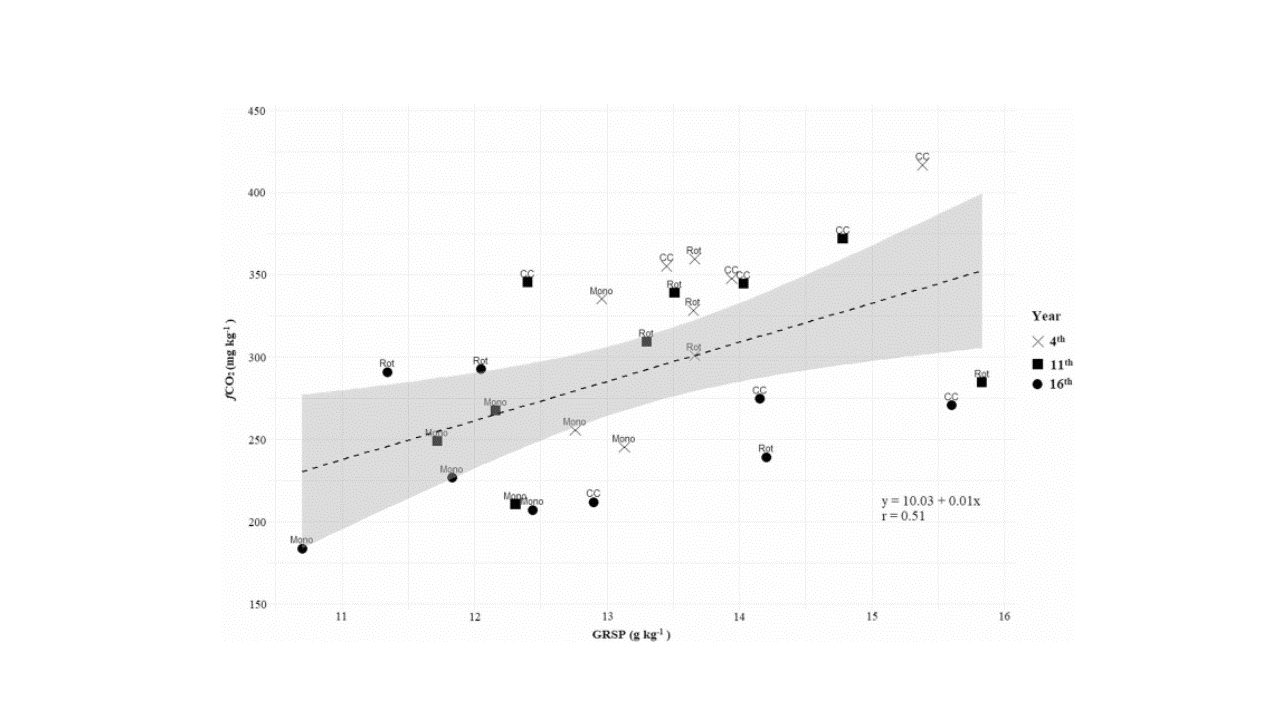
Soil health has deteriorated due to monoculture predominance and lack of crop rotations, impacting on soil organic carbon dynamics and beneficial microbial communities. This study analyzes data collected over a 12-year period within a long-term field experiment (> 16 years) to explore how different cropping systems- Monocrop (soybean, Glycine max L. Merr), Cover crop (oat, Avena sativa L./soybean), and Rotation (oat/soybean-corn, Zea mays L.-wheat, Triticum aestivum L.), influence soil organic carbon fractions, arbuscular mycorrhizal fungi related protein (glomalin-related soil protein), and soil respiration (flush of CO2). We assessed the upper soil layer (0–5 cm) at three points in time, evaluating total, particulate, and associated organic carbon, glomalin-related soil protein, and flush of CO2. Across the assessed period, the intensified cropping systems (Cover crop and Rotation) significantly enhanced total organic carbon and microbial activity (glomalin-related soil protein and flush of CO2) compared to Monocrop systems. Particulate organic carbon showed to be responsive to environmental stressors while associated organic carbon increased progressively, suggesting a potential improvement in soil stability. Although glomalin-related soil protein levels showed a decreasing trend, it was positively correlated with total organic carbon and flush of CO2. Our finding emphasizes that sustainable crop management enhances soil carbon storage and microbial function, which are the key for addressing climate challenges.