Mundo Nano, 19(37), July–December 2026, 2026
Micaela Belén Gallo, Andrés Torres Nicolini, Sergio Iván Martínez, Analía Edith Perelló, Vera Alejandra Álvarez, Verónica Fabiana Consolo
Highlights
- Green biosynthesis of CuONPs from Trichoderma harzianum produced nanoparticles with elongated fiber morphology.
- CuONPs inhibited the mycelial growth of aggressive PoT strains and induced hyphal vacuolization and thinning.
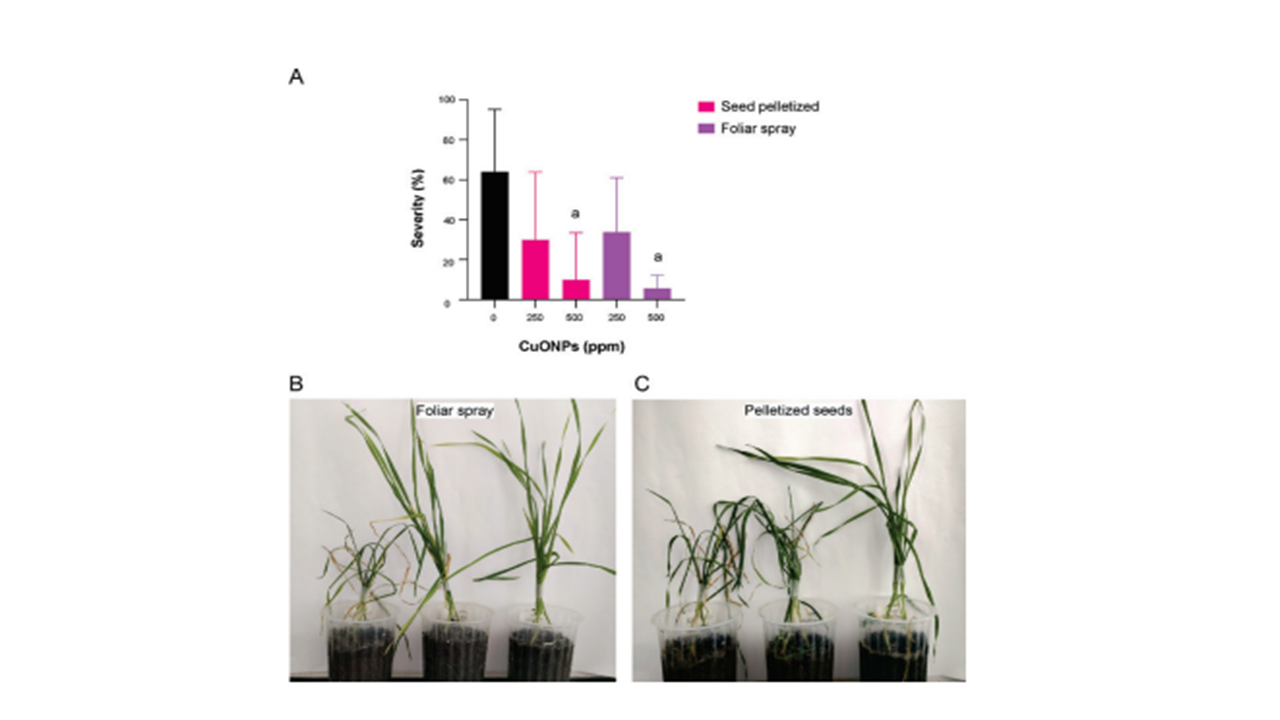
- Foliar spraying and seed pelletizing treatments with CuONPs effectively controlled the progression of wheat blast disease.
- A 500 ppm dose of CuONPs achieved a reduction in disease severity of up to 95% in wheat plants under controlled conditions.
- These biogenic nanoparticles represent a sustainable and promising alternative to synthetic fungicides for managing the emerging threat of wheat blast
Abstract
Wheat blast, caused by the fungus Pyricularia oryzae Triticum pathotype (PoT), is a devastating disease in South America, Asia and Africa due to limited fungicide effectiveness and a lack of resistant varieties. More recently, it has also been detected in Africa, further exacerbating the global threat posed by this pathogen. In Argentina, it has been detected since 2012, but although no outbreaks have yet been recorded, this pathogen represents an imminent risk due to its presence in the nearby countries. For that, new strategies should be considered for controlling the disease and proper surveillance. Nanotechnology can contribute to protecting crops since it offers different mechanisms of action against pathogens. Thus, metallic oxide nanoparticles obtained by physicochemical or biogenic methods can act as antimicrobials. This study involved the biosynthesis of green copper oxide nanoparticles (CuONPs) from the fungus Trichoderma harzianum and evaluation of their ability to reduce fungal mycelium growth and wheat blast disease symptoms in plants. Physicochemical characterization of the CuONPs performed by TEM and EDS showed elongated fibers in shape and an average size of 397 ± 55 nm in length and 124 ± 13 nm in width, as good physico-chemical stability. In vitro and in vivo experiments to evaluate the potential of CuONPs against PoT showed that they were effective in strongly inhibiting the mycelial growth of PoT native aggressive strains PY15, PY22 and PY34 by 74, 72 and 67% respectively, at a concentration of 1000 ppm. Moreover, CuONPs at a concentration of 500 ppm applied as a foliar spray on wheat plants inoculated with PY34 caused a reduction of 95% in disease severity. Further, wheat plants in which their seeds were previously pelletized with 500 ppm CuONPs showed a disease symptom reduction of 90%. These findings confirm that the biosynthesized CuONPs have a promising antifungal activity, which could be used as protection of wheat against PoT pathogen.