Nature Scientific Reports, 15:3252, 2025
Micaela Belén Gallo, Andrés Torres Nicolini, Sergio Iván Martínez, Analía Edith Perelló, Vera Alejandra Álvarez, Verónica Fabiana Consolo
Highlights
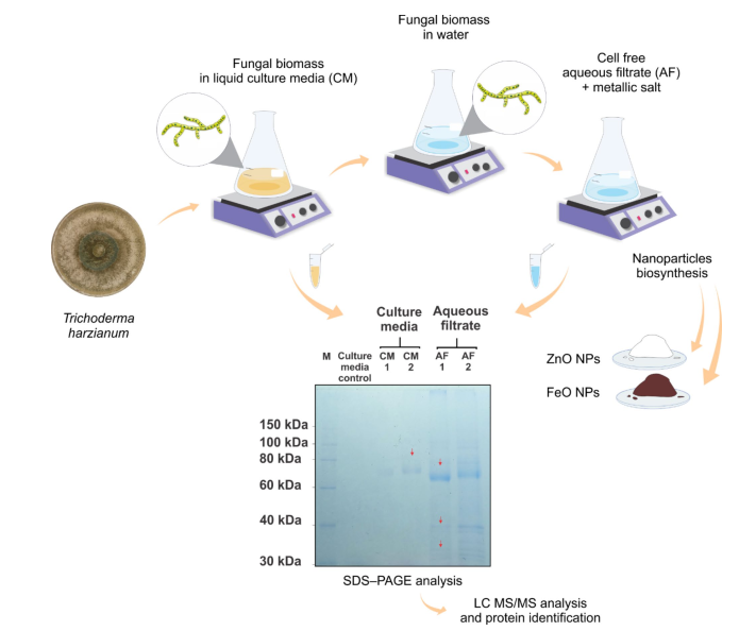
In this study, we characterized the secretome from a strain of T. harzianum grown on the culture media and also of the aqueous filtrate used as a solution for the biosynthesis of metal nanoparticles. Although few proteins related to primary metabolism were identified in the culture media, a large number of proteins associated with stress response and cellular communication were identified in the aqueous filtrate, such as oxidoreductases and peroxidases. In this sense, only a few works have reported a plethora of enzymes as agents that intervene in the reduction of metal salts to obtain NPs. As validation of protein functionality, two types of nanoparticles, ZnO and FeO, were successfully synthesized and identified as zincite and magnetite, respectively, which have not been previously reported for T. harzianum. Further, FTIR studies demonstrated some functional groups such as carbohydrates, amides, and proteins attached to NPs that probably act as capping agents. This work contributes to understanding the key role of low molecular mass proteins secreted by the fungus in intervening in the process of biogenesis of metallic NPs, opening new possibilities and strategies for their application in biotechnology, given that this fungus and its biosynthetic process is economical, simple, and harmless to humans and the environment.
Abstract
The fungal green synthesis of nanoparticles (NPs) has gained great interest since it is a cost-effectiveand easy handling method. The process is simple because fungi secrete metabolites and proteinscapable of reducing metal salts in aqueous solution, however the mechanism remains largelyunknown. The aim of this study was to analyze the secretome of a Trichoderma harzianum strain duringthe mycobiosynthesis process of zinc and iron nanoparticles. Different profiles of proteins secreted bythe fungus grown in the culture media or in the aqueous filtrate were observed through SDS‒PAGEand LC‒MS/MS analysis identifying 99 and 304 proteins, respectively. Particularly, in the aqueousfiltrate proteins of metabolic processes and stress response mainly oxidoreductases, were identified.Successfully, ZnO and FeO NPs were synthesized and characterized by transmission electron microscopy, energy dispersive X-ray spectroscopy, dynamic light scattering, thermogravimetric, and FTIR analysis. FTIR revealed organic compounds in nanoparticles acting as probable capping agents. This research is the first report in which a proteomic analysis identifies multiple enzymes involved in the biogenic process of NP biosynthesis from T. harzianum, and its role is clearly demonstrated by the formation of zincite and magnetite nanoparticles.