Plant Physiology and Biochemistry, 240, 111922, 2026
García, L. A., Giorgi, M. E., Arce, D. P., Chimenti, C. A., Tognetti, J. A., Dosio, G. A., Martínez-Noël, G. M.
Highlights
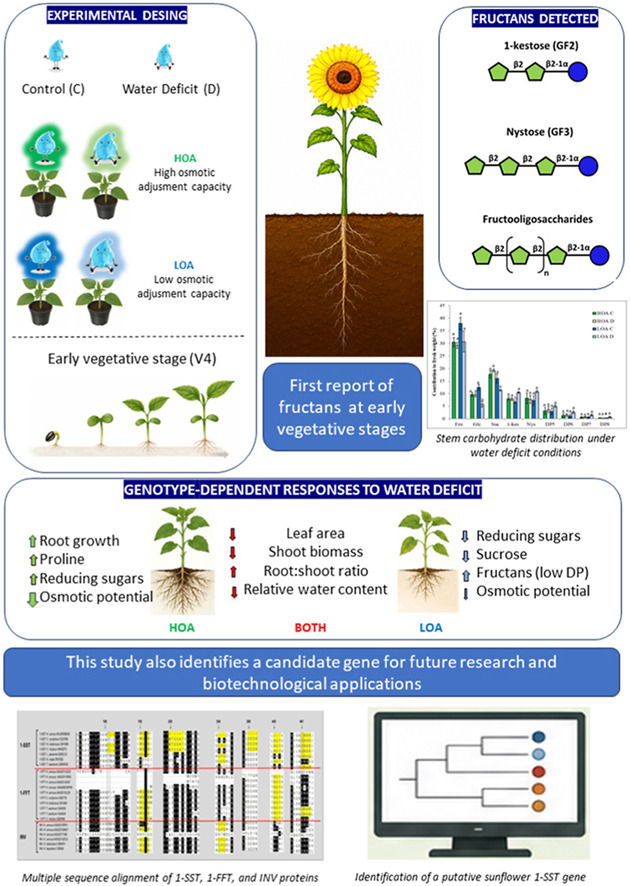
•First report of the presence of fructans during early sunflower growth.
•Contrasting lines show distinct carbon partitioning into short-chain stem fructans.
•A putative fructan synthesis gene was identified and characterized.
•Genotypes display contrasting morphophysiological root development under drought.
Abstract
Water deficit constrains sunflower (Helianthus annuus L.) productivity during the early growth stages. This study evaluated the physiological and morphological responses, as well as carbohydrate metabolism of two inbred sunflower lines with contrasting capacities for osmotic adjustment—high (HOA) and low (LOA)—subjected to a short-term water deficit during the early vegetative stage. Under restricted water availability, both lines experienced reductions in leaf area and shoot biomass. The HOA line, however, increased its root dry weight and root-to-shoot ratio, alongside increases in root elongation, volume, and length density. Proline made a substantial contribution to the calculated osmotic potential of HOA plants. Interestingly, the data confirmed the presence of 1-kestose and nystose under both water conditions, providing the first evidence of inulin-type fructan accumulation in the stems of sunflower plants at the early vegetative stage. Chromatographic profiling revealed higher levels of short-chain fructans in the LOA line under water stress. Furthermore, bioinformatic analysis identified putative sunflower genes encoding fructan synthesis enzymes (1-SST and 1-FFTs). Public transcriptomic data indicated that drought induces 1-SST expression in shoots across both drought-tolerant and drought-sensitive lines, but in roots only in the drought-tolerant genotype. These findings advance our understanding of fructan metabolism in sunflower responses to water deficit and identify questions for future research on the potential biotechnological relevance of fructans.